


Future-Proofing the Classroom: Why Further Education Needs the Canon R Series
-800x450w.jpg "Future-Proofing the Classroom: Why Further Education Needs the Canon R Series")
Future-Proofing the Classroom: Why Further Education Needs the Canon R Series
For years, the Canon EOS 2000D has been the reliable workhorse of photography departments. It’s a solid, tactile introduction to the world of manual exposure. However, as the industry undergoes a seismic shift toward mirrorless technology, the "old reliable" DSLRs are beginning to show their age—not just in specs, but in how they prepare students for the professional world.

Upgrading your department’s stock to the Canon R Series isn't just about getting "shinier" gear; it’s about pedagogical efficiency and ensuring your students are learning on the tools they will actually use in the industry.
The Evolution: Why Mirrorless?
In a learning environment, the transition from DSLR to mirrorless offers three transformative benefits:
- "What You See Is What You Get": The Electronic Viewfinder (EVF) allows students to see the effect of their settings (ISO, Aperture, Shutter Speed) in real-time. This eliminates the "chimping" cycle of taking a photo, checking the back screen, and adjusting, allowing for a much faster grasp of exposure theory.
- Advanced Eye-Tracking AF: Modern mirrorless cameras use deep-learning AI to track subjects' eyes. This allows students to focus on composition and lighting rather than struggling with the technical frustration of missed focus.
- Hybrid Capabilities: Today’s curriculums often blend photography with content creation. The R Series offers significantly better video autofocus and stabilization than any entry-level DSLR.
.jpg)
The Student Workhorse: R100 vs. 2000D
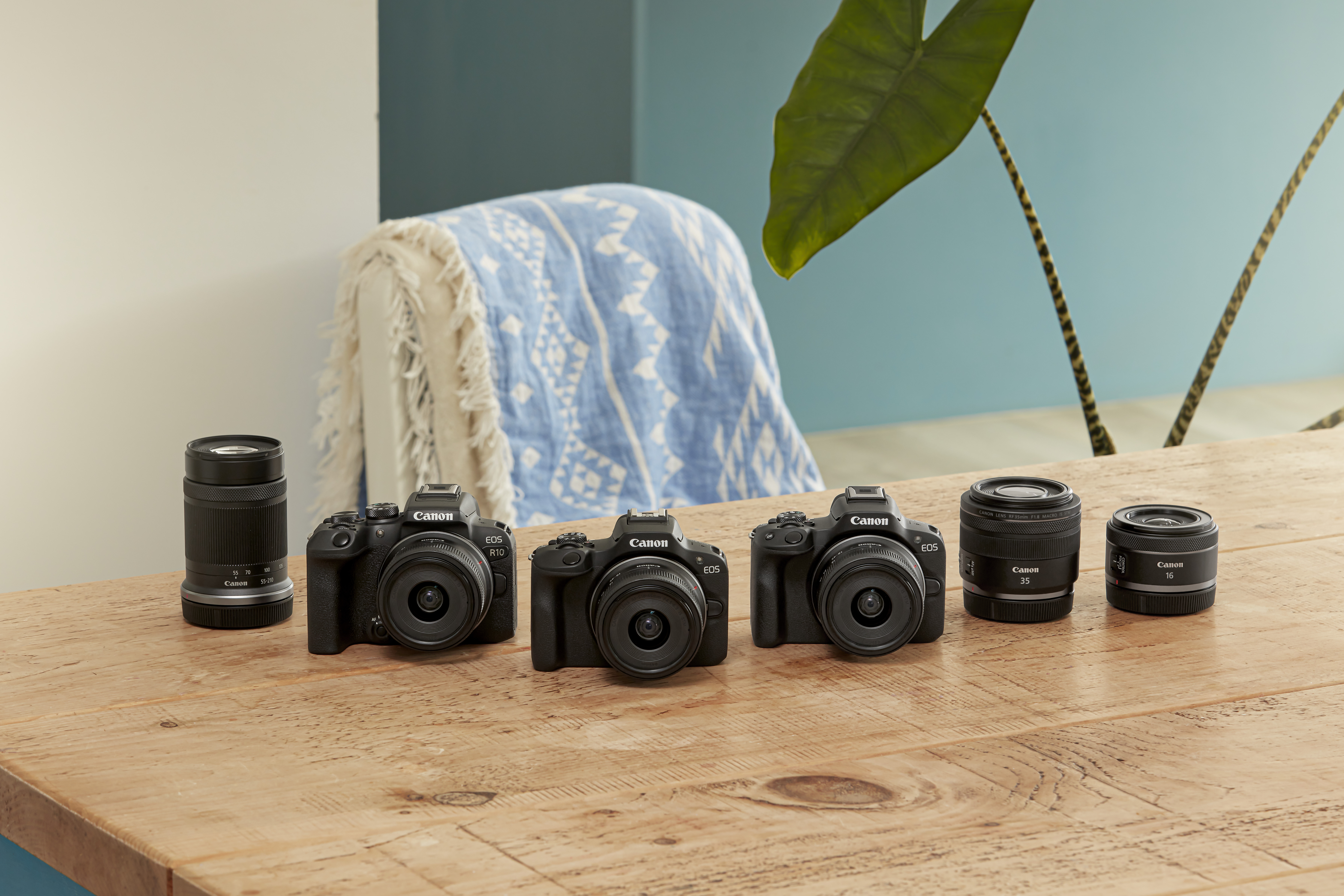
If the 2000D was the entry point of the last decade, the Canon EOS R100 is its modern successor. Here is why the R100 is a superior choice for the classroom:
|
Feature |
Canon EOS 2000D (DSLR) |
Canon EOS R100 (Mirrorless) |
|
Processor |
DIGIC 4+ (Dated) |
DIGIC 8 (Modern, faster) |
|
Autofocus |
9-point Phase Detect (Static) |
Dual Pixel CMOS AF with Eye Detection |
|
Video |
1080p @ 30fps |
4K Video & 120fps Slow-Mo (at 720p) |
|
Portability |
Bulkier, heavier |
25% lighter and more compact |
|
Burst Rate |
3 fps |
6.5 fps |
While the 2000D is a fine tool for learning the basics, the R100 feels like a tool for the 2020s. Its ability to track a student moving through a scene or record high-quality video for social media modules makes it a far more versatile asset for a modern college.
Protecting Your Investment: The EF-EOS R Adapter
One of the biggest hurdles for any department head is the existing cabinet full of EF and EF-S lenses. The good news? You don't have to replace them.
The Canon Mount Adapter EF-EOS R allows you to use every single one of your old lenses on the new R-series bodies with zero loss in quality. In fact, many older lenses actually perform better on mirrorless bodies because the camera's focus system sits directly on the sensor, eliminating the "back-focusing" issues common in older DSLRs.
Pro-Tip: If you have the budget, the "Control Ring" version of the adapter adds a customizable dial to your old lenses, giving students an extra physical point of control for ISO or Exposure Compensation.
New Horizons: Sigma's RF-S Expansion
The ecosystem for Canon’s cropped-sensor (APS-C) cameras like the R100 and R10 has recently exploded thanks to Sigma. As of late 2024 and throughout 2025, Sigma has released its acclaimed "Contemporary" line for the Canon RF mount.
- Fast Primes: Lenses like the Sigma 16mm, 30mm, and 56mm f/1.4 provide students with affordable access to professional-grade "bokeh" and low-light performance that was previously difficult to achieve on a kit lens.
- The Ultimate Kit Lens: The Sigma 18-50mm f/2.8 DC DN is a game-changer for departments. It provides a constant f/2.8 aperture throughout the zoom range, making it the perfect "one-and-done" lens for student projects.
Conclusion
Upgrading to the R Series—specifically the R100—provides your students with a more intuitive learning curve and a more professional output. By utilizing adapters for your current glass and looking toward the new Sigma RF-S line for future growth, you can modernize your department without discarding years of investment.